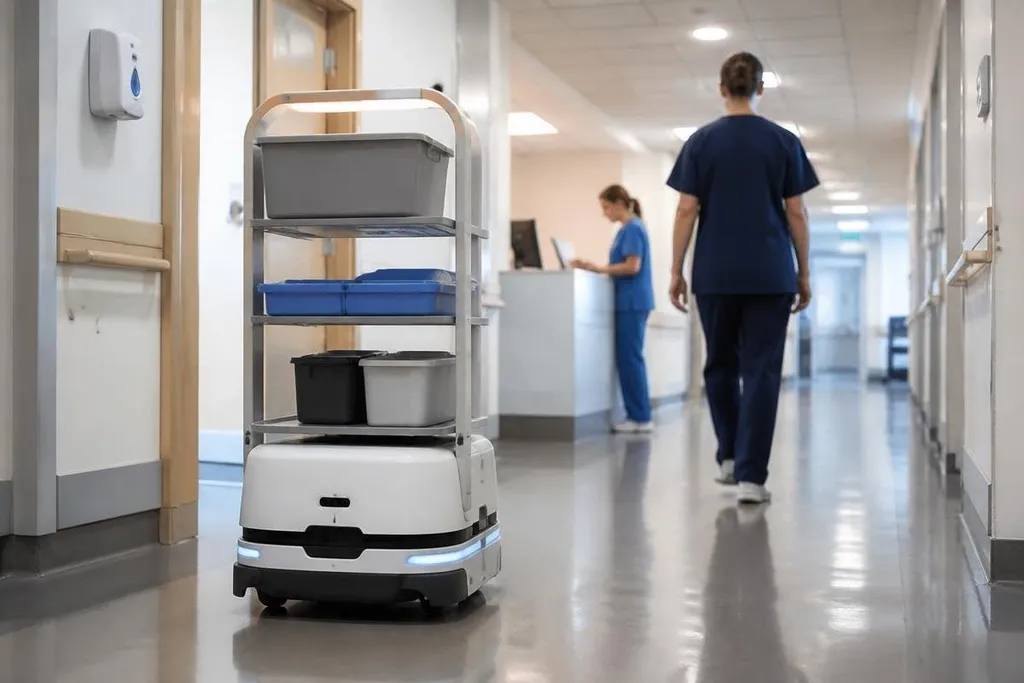
A healthcare robot may spend most of its time moving supplies, guiding patients, or helping with exercises. The less visible work matters because it can change how staff spend their shifts and how patients manage care at home.
- Supply robots could move medicines, meals, and waste between hospital rooms.
- Rehab systems could guide repeated movements and record progress.
- Home robots would need safe contact, clear controls, and a human backup.
Hospitals would start with routine work
Hospitals contain many repeated trips. A mobile robot could carry linen, samples, meals, or sealed medicine containers along marked routes.
It would need cameras, depth sensors, and software that lets it stop for people and objects in its path.
That work has a clear measure: how many trips the robot completes without a manual rescue, delay, or safety stop. A robot that moves one cart but needs a staff member beside it may add work instead of removing it.
The same rule applies to room support. A robot could bring a nurse a stored item, record a delivery, or carry waste to a collection point. It shouldn't decide what treatment a patient receives. A staff member must remain responsible for the care decision.
In a hospital, the hard question starts after a robot reaches the room: who checks the item and stops the machine? Robot24.com gives that question a factual base through reports on named robots and the staff supervising them.
Care robots would work close to people
Rehabilitation is a different task from transport. An exoskeleton, robotic arm, or motorized exercise system would need to guide a patient through a set movement while sensing force and position. The system must stop when a motion exceeds its safe range.
Repeated practice is where a machine may help. A therapist could set the movement, watch the session, and change the settings as the patient improves. The robot would handle the repeated motion, while the therapist reads pain, balance, fatigue, and other signs that a sensor may miss.
A home system would face harder conditions. Floors, furniture, pets, poor lighting, and family members would change from one house to the next. Voice controls may help a person with limited movement, but the robot still needs a physical stop button that is easy to find.
Personal data adds another limit. A care robot may record movement, speech, room activity, or medication use. Families need clear answers about where that data goes, who can see it, and how long the system keeps it.
Surgery and diagnosis need a human lead
Robotic surgical tools can give a doctor fine control inside a small working area. A system may filter hand tremor or hold an instrument steady, but the doctor still chooses the action and watches for changes in the patient.
Diagnosis brings a different risk. Software may sort scans or flag a pattern for review, yet a flag is not a diagnosis. The hospital must check how often the system misses a real problem and how often it sends staff toward a harmless one.
The open question is less about whether a robot can perform one task. It is whether the full service still works when a sensor fails, a network drops, or a patient behaves in a way the system has not seen.
A practical test before use
A hospital team or family comparing a healthcare robot can check these points:
- Name the task: Write down the exact job, such as moving a cart or guiding a knee exercise.
- Set the human role: Identify who starts, watches, stops, and checks the robot's work.
- Measure failure: Record missed objects, false alerts, unsafe stops, and calls for manual help.
- Check the setting: Test lighting, floor surfaces, door widths, noise, and the people near the robot.
- Review the data: Ask what the robot records, where it stores the files, and who can access them.
- Plan the fallback: Keep a manual process ready for power loss, network failure, or a sensor fault.
I’d be cautious about home care robots that promise independence without showing their failure process. A machine can assist with a narrow task; safe care still depends on people who can notice trouble and act when the machine stops.
The next useful measure is simple: how often does the robot finish its assigned task, and how often does a person have to take over?